In Part I, How the World Became Flat, Friedman visits India, where
he realizes that the playing field has been leveled, meaning that a much
larger group of people can compete for global knowledge. He pursues examples
of this metaphor in other places, such as Iraq, China, Japan, and the
United States. Friedman argues that there are primarily ten forces that
flattened the world and describes each of the following flatteners:
11/9/89, the fall of the Berlin Wall; 8/9/95, or the date that Netscape
went public; work flow software; uploading; outsourcing; offshoring; insourcing;
in-forming; and the steroids. Next Friedman explores what he calls the
triple convergence, or the way the ten flatteners converged to create
an even flatter global playing field. The first convergence encompasses
how the ten flatteners came together in such a way that they created a
global, Web-enabled platform that allows for multiple forms of collaboration.
The second convergence is the appearance of a set of business practices
and skills that make the most of the ten flatteners, thus enhancing the
flatteners' potential. The third convergence is the entrance of some three
billion people onto the playing field. The triple convergence is likely
to cause some chaos and confusion. Friedman argues that the great sorting
out will recalibrate the ceilings, walls, and floors that define us.
Some questions that arise during the great sorting out are: what should
be the relationship between companies and the communities in which they
operate?; how do we navigate our multiple identities as consumers, employees,
citizens, taxpayers, and shareholders?; who owns what, particularly in
the case of intellectual property?
In Part II, America and the Flat World, Friedman begins by claiming
that free trade is still in the United States' best interest because as
long as the global pie keeps growing--that is, as long as more people
demand these goods and services, more people will be needed to produce
them. Friedman points out that the Chinese and Indians are racing Americans
to the top, not to the bottom. This race will foster higher standards
for everyone. Friedman shows how, as services and goods become increasingly
tradable, more jobs are likely to become outsourced, digitized, or automated.
He predicts that untouchable jobs in the new flat world will fall into
three, broad categories: people who are special or specialized (e.g.
Madonna, Michael Jordan, or your brain surgeon); people who are localized
and anchored (e.g. waitresses, lawyers, plumbers, nurses, etc.); and
the old middle jobs (e.g. people in the middle class who are under pressure
because their jobs are becoming tradable). Friedman explores what he thinks
the new middle-class jobs will be in the flat world, calling the people
who will occupy those jobs--which he divides into eight categories-- the
new middlers.
The eight categories are: Great Collaborators and Orchestrators, The
Great Synthesizers, The Great Explainers, The Great Leveragers, The
Great Adapters, The Green People, The Passionate Personalizers, and
The Great Localizers. Friedman outlines four skill sets and attitudes
that educators and employers point to as the right stuff to make it
in the flat world. The first skill set individuals must possess is the
ability to learn how to learn. The second skill set is what Friedman
dubs CQ + PQ > IQ, or that curiosity and passion, combined, are more
important than intelligence. The third skill set/ attitude Friedman uncovers
is Plays Well with Others. The final skill set Friedman believes will
be necessary in the flat world is The Right Brain Stuff. Friedman believes
that the United States is uniquely suited to enter the age of the flat
world because it has a mix of institutions, laws, and cultural norms
that produce a level of trust, innovation, and collaboration that has
enabled us to constantly renew our economy and raise our standard of living.
The problem, it seems, is that Americans are not taking advantage of their
nation's potential.
Friedman unveils six dirty little secrets, which help explain why Americans
are not taking advantage of these resources and what will happen if they
do not change course. The dirty little secrets are: The Numbers Gap,
The Education Gap at the Top, The Ambition Gap, The Education Gap
at the Bottom, The Funding Gap, The Infrastructure Gap. Next Friedman
outlines the five action areas of compassionate flatism, which is what
he believes it means to be progressive in a flat world. The goal of compassionate
flatism is to reconfigure the old welfare state to give Americans the
outlook, education, skills, and safety nets they will need to compete
against other individuals in the flat world. The five action areas are:
leadership, muscles, good fat, social activism, and parenting.
In Part III, Developing Countries and the Flat World, Friedman considers
what policies developing countries must carry out to thrive in the flattening
world. These steps include: introspection, commitment to more open and
competitive markets, and the cultivation of infrastructure, education,
and governance, as well as the creation of business-friendly environments.
Friedman then offers Ireland as an example of a nation that went from
the sick man of Europe to the rich man by addressing these issues. Friedman
believes that to truly understand a country's economic performance, one
must also consider its culture. Friedman argues that open cultures, which
are best able to adopt global best practices and willing to change--versus
closed cultures, which promote tradition and national solidarity--have
the best chance for success in the flat world. Finally, Friedman observes
that even when nations get it right--reform wholesale, reform retail,
maintain good governance, infrastructure, and education, as well as glocalize--some
proceed in a sustained manner while others do not. Friedman calls the
missing element the intangible things. Friedman boils the intangibles
down to two basic elements: a willing society and leaders with vision.
Friedman provides a comparison between Mexico and China to show how Mexico
failed and China succeeded.
In Part IV, Companies and the Flat World, Friedman imparts an observation
he has made while researching this book, which is that the companies
that have managed to grow today are those that are most prepared to change.
Friedman shares seven rules he has learned from these companies. Rule
#1 is When the world goes flat --and you are feeling flattened-- reach
for a shovel and dig inside yourself. Don't try to build walls. Rule
#2 is And the small shall act big... Rule #3 is And the big shall act
small... Rule #4 is The best companies are the best collaborators.
Rule #5 is that In a flat world, the best companies stay healthy by getting
regular chest X-rays and then selling the results to their clients. Rule
#6 is that the best companies outsource to win, not to shrink. Rule
#7 is that Outsourcing isn't just for Benedict Arnolds. It's also for
idealists.
In Part V, Geopolitics and the Flat World, Friedman explores some
of the reasons why flattening could go wrong. He sets out to answer the
following questions: What are the biggest constituencies, forces, or
problems impeding this flattening process, and how might we collaborate
better to overcome them? The groups of people for whom the world might
not flatten are comprised of those who are too sick, too disempowered,
and the too frustrated. Friedman notes that if the many people that
live in the unflat world enter the flat world (as they are beginning to
do) there will be an environmental crisis. He urges Americans to take
seriously the damage they are wreaking on the environment through their
waste. He believes it is in the U.S.'s best interest to collaborate with
China and India to reduce energy consumption. In becoming the Axis of
Energy these nations could effectively disempower the Axis of Evil.
Friedman also considers the surprising, important, and paradoxical effects
flattening is having on culture around the world. Initially, Friedman
says, there was concern that globalization was really Americanization
in the form of American cultural imperialism. This is because American
cultural products (films, music, chain restaurants, etc.) were in the
best position to take advantage of the flattening of the world. However,
Friedman believes that while the flat world platform has the potential
to homogenize cultures, it has a greater potential to foster diversity
to a greater degree than has ever happened before. The primary reason
for Friedman's outlook is uploading's capacity to globalize the local.
That is, because anyone with access to a computer and the Internet can
put content on the Web, local culture can be spread globally. Friedman
is aware that there are also negative aspects of flattening's effects
on culture. He notes that the potential is just as great for criminal
groups to come together in this smaller world as it is for progressive
groups and mentions the pedophiles that paid Justin Berry to perform sexual
acts in from of a web-cam for several years. Friedman establishes The
Dell Theory of Conflict Prevention based on Dell's Asian supply chain,
arguing that nations deeply invested in just-in-time global supply chains
are much less likely to engage in war than they were previously (old-time),
because they will withstand significant financial losses. This is relevant
to Friedman's larger arguments about the flat world because Friedman contends
that war substantially slows (or stops) flattening. According to Friedman's
theory, countries such as Japan, South Korea, China, Taiwan, Malaysia,
Singapore, the Philippians, Thailand, and Indonesia can work together
and resist war, despite political or cultural differences, because they
are all economically invested in a supply chain. Conversely, nations such
as Iraq, Syria, south Lebanon, North Korea, Pakistan, Afghanistan, and
Iran are not part of any major global supply chains and, therefore, remain
hot spots because they will not suffer similar economic set backs due
to war. Friedman notes that supply chains are not always good. The technology
that enables countries to become more competitive and economically secure
also enables terrorist organizations, such as al-Qaeda or suicide bombers
in Iraq. Friedman reminds the reader that Osama bin Laden did not use
nuclear weapons on 9/11 because he did not have the capability, not because
he did not have the desire. Friedman argues that the best way we can combat
suicide supply chains is by limiting the supply of nuclear weapons.
|
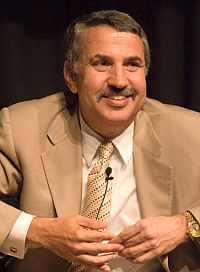 Thomas L. Friedman |
In Part VI, Conclusion: Imagination, Friedman emphasizes the competing forms
of imagination at work in the world today, which are seen in the differences
of 11/9 (the day the Berlin Wall came down) and 9/11. For Friedman, 11/9
represented a more open world. 9/11, conversely, demonstrated how evil
imaginations could close the world up. Friedman unfurls how the plans
for 9/11, as elaborated in the 9/11 Commission Report,
were similar to many business ventures, with Khalid Sheikh Mohammed
the eager engineer-entrepreneur and Osama bin Laden the wealthy venture
capitalist. Friedman argues that technology such as iris scans and x-ray
machines will help thwart those who are trying to destroy the flat world,
but technology alone will not keep us safe. Additionally, we must affect
the imaginations of those who would use the tools of the flat world to
terrorize others. Friedman closes with an anecdote about dropping off
his oldest daughter, Orly, at college in the fall of 2004. This was one
of the saddest days in Friedman's life, not only because his daughter
was growing up, but because he felt this world was so much more dangerous
than the one she was born into.
Thomas L. Friedman - BIOGRAPHY
Thomas Friedman was born in St. Louis Park, Minnesota on July 20, 1953. He graduated in 1975 from Brandeis University with a Bachelor's degree in Mediterranean Studies. In 1978, Friedman received a Master's degree from Oxford University in Modern Middle East studies. Friedman began working as a correspondent for the New York Times in 1981 and spent many years reporting from Israel. Friedman was awarded the Pulitzer Prize in 1983 and 1988 for international reporting. In 2002, Friedman received a third Pulitzer for commentary. Thomas Friedman is married and has two daughters.
Selected Works:
From Beirut to Jerusalem, 1989
The Lexus and the Olive Tree, 1999
Longitudes and Attitudes: Exploring the World After September 11, 2002
The World Is Flat: A Brief History Of The Twenty-first Century, 2005
The World Is Flat: A Brief History Of The Twenty-first Century, The
Updated and Expanded Version, 2006
GENRE
Non-Fiction
Clapsaddle, Diane. "TheBestNotes on A Long Way Gone".
TheBestNotes.com.
>.