THEMES
Major Themes
There are two over-arching themes which encapsulate all the other major and minor themes in the book, sometimes individually and sometimes combined. The first over-arching theme is Coming of Age - that is, the point when an entity matures into a fully-developed state, whether it's a young man or a nation. The second such theme is Order Versus Chaos: the tension created between these two values, and the role each plays in life.
From these two themes, other major themes also develop. First, there
is the Nature of War, which in this book alternates between the order
of strategic planning and the chaos of actual battle. Closely related
to this is the theme of the American Revolution, the historic setting
which is set off in the events of this story; of course, this ties into
the idea of a Coming of Age - but for a country instead of an individual.
Another related major theme is the Nature of Authority - that is, how
men can rule other men and what boundaries must be observed: authority
is the imposition of order, however its abuse can lead to the chaos witnessed
in this book. A last major theme in the novel is Family: it is the source
or order in most young lives, but in order to mature one must be able
to look at one's family in a new manner and understand one's role in it
as an adult.
Minor Themes
Masculinity is a minor theme that adds a dimension to the Coming of
Age theme for both Adam Cooper and the nascent America. Broad issues are
engaged in passing, as this is a story about growing up and coming to
terms with the realities of life: thus, the Nature of Love is an important
minor theme for certain characters, as is the Nature of Religion. The
last minor theme is Literature & History - specifically the way the
two are connected - is another minor theme that pops up throughout the
course of the book.
MOOD
The mood of the story is somber, very serious and straightforward in
its handling of the events. Certain cues in the book also indicate that
the narrator is telling the story from some point well into the future,
adding a sense of nostalgia as well, an elegiac longing for simpler, more
innocent times in the narrator's life.
Howard Fast - BIOGRAPHY
Howard Melvin Fast was born in New York City on November 11, 1914. He was the son of Jewish immigrants from different lineages: his mother Ida was a British Jew, while his father Barney Howard Fast was the son of Ukrainian immigrants. Howard Fast's mother died in 1923, and Howard was left to work at an early age. A voracious reader, he took to writing and his first novel, 1933's Two Valleys was published when Fast was nineteen; his first work to earn major acclaim, the historical novel Citizen Tom Paine, was published ten years later in 1943. Many critics agreed that this work served to rehabilitate the opinion of Thomas Paine. The following year saw Freedom Road, a novel set in the Reconstruction-era South about a former slave who becomes a United States Senator; the book was adapted into a television miniseries in 1979 starring boxer Muhammad Ali.
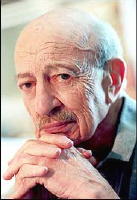 Howard Fast |
The work Fast is best known for today is 1951's Spartacus, which had been adapted into a film in 1960 by actor Kirk Douglas. This famous novel about a revolt by slaves in ancient Rome was written while Fast was in jail the previous year: he was imprisoned for three months by the House Un-American Activities Committee (HUAC) for refusing to name contributors to a fund that supposed orphans of American veterans from the Spanish Civil War. He was blacklisted - that is, refused work in film and publishing because of his political affiliations - and so had to publish under his own imprint, Blue Heron Press. Fast did not bow under pressure, but continued to support leftist causes: he ran for Congress for the American Labor Party in 1952, wrote for the Communist Party Daily Worker, and in 1953 was awarded the Stalin Peace Prize. Fast broke with the Communist Party in 1956, in protest of the direction the Soviet Union was taking, particularly regarding the treatment of satellite nations such as Hungary.
1961's April Morning was not intended as a Young Adult novel by Fast, however it has become a staple of many classrooms. A novel focused on a fictional teenager taking part in the battle which started the Revolutionary War, The Battle of Lexington and Concord, a film version was made in 1988. Though best known for his many historical novels, Fast tried his hand at most every major genre in his highly prolific seventy year career. Under the pseudonym E.V. Cunningham, he had written a series of detective stories featuring the Asian American character Masao Masuto, as well as a series of suspense mystery novels whose titles were taken from women's names, starting with 1960's Sylvia and ending with 1973's Millie. Under his own name he also wrote a series devoted to the Lavette family saga, beginning with 1977's The Immigrants and ending with 1997's An Independent Woman. The first book was adapted into a television miniseries.
Fast married Bette Cohen in 1937 and had two children with her. Their
son Jonathan Fast became a novelist and married feminist icon Erica Jong;
Howard Fast's granddaughter Molly Jong-Fast is herself a novelist as well.
Bette Fast died in 1994 and Howard remarried in 1999 to Mercedes O'Connor.
In 2000 he published his last novel, Greenwich. Howard Fast died
on March 12, 2003, leaving behind a literary legacy that not only spans
much of the twentieth century, but reflects the rich pageantry of American
history from its very beginning.
LITERARY / HISTORICAL INFORMATION
April Morning is often categorized as a work of historical fiction, a genre for which Howard Fast wrote extensively. The key event of this novel - the Battle of Lexington and Concord - did indeed happen, though Adam Cooper and his family are fictional characters. The blending of historical facts with fictional aspects - often using a fictional protagonist to explore an era filled with real-life personages - is found in the work of other writers, such as E.L. Doctorow and William Kennedy.
This work is also a bildungsroman of sorts, meaning a novel of education or
maturation. In witnessing what he does in the span of a day, Adam learns
a great deal about himself and the world, and is said by many to have
become a man in the process. Adam's own doubt about whether or not he
has truly achieved manhood and attained wisdom is itself an affirmation
of growth, as it indicates a widened understanding of the world and its
expectations on him.
Clapsaddle, Diane. "TheBestNotes on A Long Way Gone".
TheBestNotes.com.
>.